Thursday, August 16, 2007

Days 3 and 4: Bethlehem and Beit Sahour

Hi all. Sorry I've been so late in posting this, Bethlehem and Hebron have been frenetic and unique. Arrived in Ramallah today and have only just sat down at leisure for the first time in 3 days.

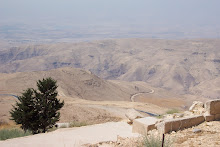
On day 3, we took a shared Palestinian taxi from Jerusalem to Bethlehem. It is a hot, dusty drive through spectacular hills and ravines. Distances in Palestine are short- when you are not stopped at checkpoints. Half an hour after we set off, we were asked to get down by the driver. We thought there must be a problem because there was no city in sight. Sensing our confusion, he said- 'Welcome to Bethlehem'.

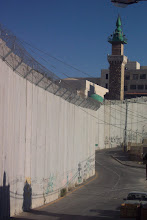
And what a welcome it is. The reason you don't see Bethlehem is that it is hidden by the hulking mass of the wall. The Israeli Ministry of Tourism has painted a mural on it- 'PEACE BE WITH YOU'. That must be the sickest joke ever. The checkpoint is called a 'terminal' by the Israelis. You pass through a series of turnstiles, like an airport. To our surprise, we were simply waved through- probably because we were a predominantly 'white' tourist group. However we witnessed a female security guard harassing a queue of Palestinians trying to cross. The turnstiles are so narrow that if you have anything more than a small bag, you get stuck. There are no other provisions for pregnant women or people in wheelchairs.

We proceeded to Beit Sahour, a suburb of Bethlehem where our hosts the Alternative Tourism Group http://www.atg.ps/ are based. We were warmly received by JM, who has a limp from being shot in the leg. We learnt that Beit Sahour is a predominantly Christian town which played a huge role in the second Intifada- people burnt their Israeli ID cards and refused to pay their taxes. As a result a continuous curfew was imposed for 42 days.

We were then taken out by the Palestinian Medical Relief Society (PMRS) to a house in Bethlehem encircled on 3 sides by the Wall. All you can see from this house is, well, the Wall. You do not realize how imposing the Wall is until you are next to it. It is a mammoth structure, topped with barbed wire. The owner of the house, Claire Anastas, came out to meet us. She explained how she was from an affluent family running several businesses, but since the Wall appeared they are forbidden- and physically unable- to see their clients on the other side. As a result they are in dire straits now. She has already been interviewed by several foreign news channels and asked us, 'What is the world doing about this? People come and ask questions but nothing happens. I don't understand politics. I only want to live a life. Why are we being punished like this?' The despair in her voice moved us to tears. Near Claire's house is Aida refugee camp which depends a lot on olive groves to sustain itself. The Wall has separated the two. You can imagine the consequences.

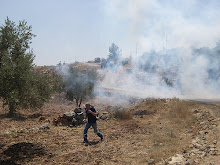
We were then taken to the villages of Wadi Nis and Umm Salamona which cultivate grapes and olives. The Wall is under construction here, with the aim of annexing the illegal settlements of Homa, Har Homa and Gilo to Jerusalem. Again, these settlements are on Palestinian land. The course of the Wall has not been decided yet but the villages are likely to be cut off from their fields. The local residents, whose leader we met, are fighting a desperate battle to prevent this from happening. They have a nonviolent protest every Friday which is regularly teargassed.

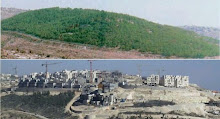
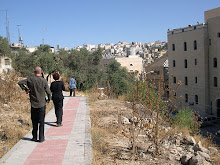
Standing on top of the hill in Wadi Nis, you get a bird's eye view of the area. The once beautiful landscape has been defaced by illegal settlements and the Wall. Har Homa stands on top of a hill which was once home to 40000 olive trees. These were cut down and destroyed by the Israelis to build Har Homa. Some were re-planted to beautify the settlements! To a Palestinian, the tree is life. It takes decades to bear fruit. Yet the Israelis have literally shaved the hills bare.

We then proceeded to meet our families. Let me explain- ATG put us up with Palestinian families in their homes. Our hostess was a delightful middle-aged Christian lady called H. Her family have lived in Beit Sahour for generations. They have always been politically active, indeed her son was put in jail for 10 months at the age of only 15 for simply protesting peacefully. He is a hotel management graduate who is now forced to work as a waiter because tourism in Bethlehem has died and WB residents are forbidden to travel to Jerusalem to find work. He could leave for abroad but never will as that would be an admission of defeat.

H told us how the families of Beit Sahour supported each other during the siege. People with food would supply those without by going from door to door in the dead of night, even though they could be shot for breaking the curfew. H said, 'even if we are left with no food and no clothes, we shall never give in. Our quarrel is not with the Jews. It is with Israel. We will not allow them to steal our dignity- which is all we have left'. She then proceeded to ply us with Palestinian food and sweets.

Day 4 was in Bethlehem as well. We were taken round by A, another Christian man whose family have been in Beit Sahour for centuries. He has spent years in jail. He was pursuing a degree at Bethlehem University when the Israelis closed it for 3 years. He was unable to complete his education, and is now working as a tour guide. He took us round more confiscated lands, settlements and barriers. And we got more and more depressed. We had some fascinating political discussions with A. Once thing that came through in our time spent with H and A is the unity displayed by Muslims and Christians. 'We are one people. Religion is not an issue. We are all Palestinians first', said A. We witnessed this in the streets- girls in hijab linking arms with girls wearing Christian crosses, and elderly men of the two faiths playing chess on the sidewalks. The rest of the world has a thing or two to learn from these wonderful people.

We got taken to the village of Beit Jala which is on top of a hill. Most of Beit Jala's land has already been usurped by the wall and the settlements. We also saw several bombed-out houses from the 2002 incursions.

We also had the chance to visit Aida and Deheisheh refugee camps. It is impossible to describe how crowded a camp is if you haven't seen one. In the case of Deheisheh, 11000 people are crammed into an area of 1 sq km. We visited the home of a 107-year-old man who lost his teenage grandson to an Israeli bullet. People ask me why Palestinian children throw stones. What harm does a stone do to a tank or a soldier wearing armour? Shouldn't the question be- why does the Israeli army shoot children throwing stones?

Our visit ended with a tour of the Church of the Nativity, where Jesus is said to have been born. This is the oldest church in the world- a huge structure, still in use for services and events like weddings. We were fortunate enough that a wedding was in process during our visit. A sound we had never heard before- Christian hymns in Arabic, set to organ music- filled the building. We visited the basement where you can see the manger in which the infant Jesus is said to have laid.

You can also see the bullet marks from the Israeli siege of the Church in 2002. When the military invaded Bethlehem, people of both faiths took refuge in the Church assuming that it would be safe, being a place of worship. However it was shelled by the Israeli forces- they respect nothing and nobody. Many died in the siege. I could sense the frustration of the Christians we met- they cannot understand why there wasn't a bigger outcry among the Christians of the world when the birthplace of their faith was being desecrated. They find it inexplicable that a large segment of Christians- the evangelicals- actually support Israel in its evil policies.

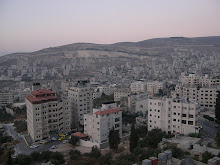
And the desecration of this once beautiful city perched on a hill continues- with the extension of the rapacious settlements and the wretched Wall, continuously gobbling up precious land and ruining the ecology. Not to mention destroying lives and livelihoods.

We ended the day by meeting S, a British surgeon who has been operating in the area for two years. She specializes in plastic and reconstructive surgery but has given up a potentially lucrative career in Britain. She is completely committed to the Palestinian cause, and intends to continue working here for as long as she is permitted.

We spent another evening with H, and had another fantastic Arab meal. We said our goodbyes and promised to stay in touch.

Tomorrow we go to Hebron. One of the scariest places on earth.

Monday, August 13, 2007

Day 2: Tel Aviv and Jerusalem

Arose bright and refreshed to a sumptuous Palestinian breakfast of breads, hummus, eggs, olives and fruits. Then 3 of us- N, K and I took a shared taxi from the Jewish area to Tel Aviv Central Bus Station.

Tel Aviv is like any modern American city- wide boulevards and gleaming glass buildings. Miri, who works for Physicians for Human Rights http://www.phr.org.il/ came to take us to her office. She is in her 20s with a bewitching smile. She introduced us to her colleagues- Jewish and Muslim- working together to campaign against the abuse of healthcare rights by Israel. She told us that till she went to university, she was a Zionist who had never met a Palestinian. However she chose to learn about their plight and is now a fierce critic of Israel. 'It isn't just an occupation,' she says. 'It is total control of every aspect of the lives of Palestinians'.

She described how Israel on a regular basis violates the right to access to health care in the West Bank- mainly by controlling movement. If you want to travel to hospital- and it could be an emergency like labour or a heart attack- you still have to pass through checkpoints. Even if you are in an ambulance. And the check isn't just a five-minute security check- a mother could be suffering the agony of childbirth and they will detain the vehicle for hours. Since the year 2000, 68 women have been forced to give birth in cars and on the ground in the baking sun resulting in 4 maternal and 34 infant deaths. People on dialysis and chemotherapy are regularly denied transit.

There are more than 700 checkpoints in the WB- and these are between Palestinian towns, not between Palestine and Israel. It is clear that their purpose is not security- it is simply to control and humiliate people and force them into leaving their country, so that Israel can chew up more and more land.

We were also shocked to learn that Palestinian ambulances are regularly shot at, and many doctors, nurses and paramedics have died as a result of this.

We also learnt of the plight of Bedouins in the Negev desert in Israel. There are 60 villages which have existed before 1948, the existence of which Israel does not recognize. As a result they have no healthcare, electricity or clean water. Their infant mortality rate is 7 times the Israeli average- in the 4th richest country in the world, with possibly the best healthcare system anywhere.

She also told us how medical students from Abu Dis University in Jerusalem have been cut off by the Wall from Maqassed Hospital, which is their main teaching centre. As a result they are forced to do their clinical years in West Bank hospitals- which Israel does not recognize! Medical students are rarely able to complete their degree in time due to checkpoints and curfews.

We also met Dr Hadas Ziv, the director of PHR. She had a simple message- the world criticizes Israel but continues to arm it to the teeth with money and weapons. While it sympathizes with the Palestinians and does nothing for them. This has got to change. As for the accusation that criticism of Israel is anti-Semitic, they said that as Jews they were fearful that Israel's actions were fuelling anti-Semitism and the only way to correct this was for Israel to come to its senses.

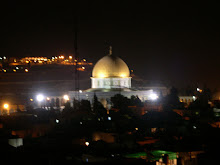
Upon our return to Jerusalem, we did a bit of sightseeing. I got the opportunity to pray at al-Aqsa, which was an overwhelming experience. I also saw the Dome of the Rock which dominates the Jerusalem skyline and is stunning, especially when illuminated at night. The Israelis have attacked the two mosques several times- once a fanatical settler tried to blow it up.

We also visited the Stations of the Cross, the route Jesus is said to have taken with his cross to his crucifixion. The Church of the Holy Sepulchre is built on the site where he is said to have been crucified and buried. It is an intensely atmospheric place, full of burning incense and chanting monks. It is not far from the Wailing Wall, of great significance to Jews. No wonder Jerusalem is called the centre of the world by some.

I only found out today that the 'Jewish' Quarter of the Old City was home to 6000 Muslim and Christian Palestinians prior to 1967. There was a small Arab Jewish population which had coexisted peacefully for years. In 1967, Israel occupied Jerusalem and destroyed over 1000 houses in this area, forcing these people into refugee camps. This area is now exclusively populated by wealthy Jews, and the lingua franca is American English. Israeli law forbids any non-Jewish person to live in this area.

We finished the day with a walk round the Old City and dinner. While we were eating at a street cafe, a group of Israeli Occupation Force (IOF) soldiers- they call themselves the IDF- D for defence (!)- sauntered past us. They must have identified our accents as English and came up to us to speak. They told us that they were having a 'fun night' and wanted us to join them in a group song called 'Moshiach'. This is at ten at night when the Old City is trying to sleep.

Needless to say, they got a disdainful 'no' from us. We would rather go to prison than sing with these gun-toting teenagers who humiliate the residents of Jerusalem on a daily basis by stopping them randomly and asking them for ID.

Anyway I'm tired and we need to go to Bethlehem tomorrow. See you then!

Sunday, August 12, 2007

Day 1: Ben Gurion Airport and Jerusalem

I'm here and I can't believe it. It'll take some time to sink in.

But it was no cakewalk. Flight uneventful enough, but Ben Gurion airport was, as I feared, an experience to remember. I got what is called 'the special treatment'.

Landed at 4 am. The other six got through without a hitch. They had the advantage of being white. We were all fully prepared- we had an itinerary all prepared and printed out which described how we would be visiting various holy sites in Jerusalem during our time here. I had made a dummy booking in a non-Arab hostel for one night. We even had glossy business cards printed out- the 'Manchester Interfaith Forum'. But when I got to the sulky female immigration officer, her eyebrows rose an inch. And she looked none too pleased to see my passport with my very obviously Muslim name. When she swiped it through her computer, an alarm must have gone off somewhere because an airport policewoman appeared and asked me to come with her. I was told to sit in an enclosure with other people selected for the 'special treatment'. Then followed six-and-a-half hours of waiting and being interrogated.

I was interviewed by four different plainclothes security personnel. The questions ranged from the mundane to the ridiculous-
Why are you here?
So you're Muslim? Are you religious? How many times a day do you pray?
What is your job? Which hospital do you work in? What is the phone number of the hospital?
What is your marital status?
Are you carrying any weapons? (as if I could have got them through Manchester airport or mysteriously acquired them on the plane!)
Do you know anybody in Israel or Palestine?
How many people are in your group? How long have you known each other? Is the Jewish lady in the group married?
What is your father's name? Your grandfather's name? How do you spell it? Where were your parents and grandparents born?
Are you planning to visit the West Bank?
Why did you choose your hotel?
Why are you of Indian origin? Why are you not of Pakistani origin when you are Muslim?

The infuriating thing was that the questions kept being repeated by the different personnel. I must have spelt out my grandfather's name five times. And after the initial interview, they kept coming up to me every now and again with one or two random questions- what was the name of your hospital again? Are you married?

N, one of the other members of our group was allowed to sit with me in the enclosure when I wasn't being interviewed. Thanks N- it was great to have you by my side.

All the other people being held had one thing in common- they were non-white. A woman of Palestinian origin but German citizenship had come to visit her family after 14 years. She was handed her baggage and told to get on the next plane to Germany.

After the interviews, I was taken into a room with two other security personnel where I was asked to unpack my baggage and hand each item over for inspection. I had been told that I might be strip searched- this did not happen, but a securityman wearing plastic gloves frisked me like nobody had frisked me before. There was no part of me he didn't run his hands over. He then asked me how much money I had brought- I then had to hand it to him so that he could count it!

At about 8 am I was told that everything seemed 'ok' but 'did I know who I shared my name with?' I answered that my name was an extremely common one and I probably shared it with millions of people- was I expected to change it because some unsavoury character somewhere in the world had the same name?

I was asked to wait another 'few minutes' because another official who wasn't there yet needed to interview me. An hour and a quarter later this officer appeared and asked me to follow him down a dark corridor, up several flights of aluminium steps, through several metal doors into what looked like a huge bank safe. It was an office with 'Ministry of Defence' written on the desk. There was an Israeli flag and a huge picture of a smiling Ehud Olmert behind the desk. I caught a glimpse of the officer's PC screen- it had a page open titled 'Crime File' with my name on it. So they were creating a file with all my details!

I was asked all the same questions again. However this time he also wanted to know-
Which countries have you visited (in your entire life?)
Did America allow you in?
Which medical school did you go to? Which city is it in? Which year did you pass out? Which cities have you worked in in the UK?
What are your siblings' names? What are their spouses' names? Where do they live and what jobs do they do? What is the name of the company your sister works for?
Do you know about the recent terror attacks by Muslim doctors in the UK? Did you work with any of those doctors? You are Muslim and a doctor- shouldn't we consider you a terrorist as well? (it was difficult to keep calm at this point but I managed somehow.)

He was constantly tapping away at his computer storing this information. I wonder what they do with all the useless information they have on people.

He then proceeded to ring my sister- it would have been about seven in the morning in London- to ask her the same questions about my work, my family and her work. He didn't tell her who he was. She gave him the true answers- when he had finished with her, he passed the phone to me. I told her I was ok- she asked me whether she had been right to speak the truth. On this occasion, yes! I was to learn later that she became extremely worried when she received the phone call- because it was several hours after I landed, she didn't know whether it was the Israelis or a Palestinian faction which was holding me and wasn't sure how to answer!
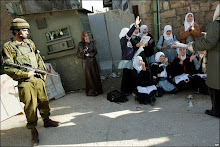
The ordeal finally ended about half-past ten. Before leaving, N and I were given a cheese and vegetable baguette. The Palestinian woman got nothing. I learnt later that my friends- who, by the way, had been sitting on the cold floor throughout my interrogation- had contacted the British Embassy who had been speaking to the Israelis every 30 mins. The embassy official thought that the reason for my detention was my religion. If he hadn't been involved, I may have been held longer- probably even sent back. And I wouldn't have got the baguette!
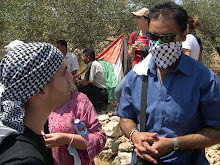
We made our way to Jerusalem in a shared taxi. When you catch your first glimpse of the Dome of the Rock, it is breathtaking. Our hotel was in the old city and we walked through a Palestinian souq teeming with aroma, colour and people to get to it. I was overjoyed to be there.

Our hotel had a fantastic view of the old city from the terrace. After a glass of mint tea, we had an hour's sleep and then had to leave to join a tour organized by the Israeli Committee Against House Demolitions (ICAHD). http://www.icahd.org/ We were taken around Jerusalem by a Jewish lady of Mexican origin called Lucia and her Palestinian colleague.

The contrast between the Jewish and Arab areas of Jerusalem couldn't be more stark. Apartheid is the only way to describe it. For administrative purposes, Israel considers all of Jerusalem to be part of Israel (though the UN regards East Jerusalem as occupied). All residents of Jerusalem- Palestinian or Israeli- pay taxes (by the way, Orthodox Jews are exempted from taxation). Despite contributing 40% of taxation, the Palestinian areas only get 7% of municipal expenditure. The Jewish areas are spanking clean with wide roads, smart cars and spotless houses. The Arab areas get no garbage disposal- we saw mounds of rubbish which had been there for weeks. At night, the shopkeepers in the souq clean the streets themselves because the municipality refuses to serve them.

Since 1967, 18000 houses have been demolished in Palestine. Sometimes with the inhabitants still in the house. People go to work not knowing whether their house will still be there when they return. The reason given for demolition is that the construction does not have a permit. Even to extend his house on his own land, a Palestinian requires a permit. This costs $20000 to apply for (and is almost always never granted). So as his family grows, a Palestinian is forced to build illegally. Then in come the bulldozers. The icing on the cake is that the inhabitants have to remove the rubble themselves and the Israeli government bills them for the demolition. So, many Palestinians have taken to demolishing their houses themselves to avoid this humiliation. We saw a block of flats housing 21 families which had recently been reduced to rubble.

(ICAHD has sworn to rebuild every house that Israel demolishes. In the past ten years they have reconstructed 101 homes- some of these, several times over. Details are on the fascinating website www.18000homes.org. You can also make an online donation there.)

If you are Jewish- from anywhere in the world- regardless of whether you or your family have any links to Israel- you can simply arrive here and start living. The government will pay for your airfare, six months rent, give you a flat and a job. You will be given discounts on mortgages. Yet you could have been living here for generations but because you are Palestinian, you could lose your house. And Israel is 'the only democracy in the Middle East'.

It is clear that Israel wishes to 'Judaize' Jerusalem. In the Old City, you see Israeli flags everywhere- these are houses in Arab areas whose inhabitants have been pushed out and illegally occupied by fanatic Jewish settlers. This continues unabated and the government turns a blind eye- I daresay it encourages it, Ariel Sharon has a flat in the Old City. The settlers harass the Arabs living in the surrounding houses- many have left as a result.

We also visited the Separation Wall in Jerusalem. I cannot describe how ugly this structure is. 8 metres high and topped with barbed wire, it is twice the height of the Berlin Wall. Here it cuts through a Palestinian neighbourhood, separating people on the other side from their schools, universities and offices. We visited a shop next to the Wall whose business has been destroyed by it as all his customers are trapped on the other side.

We also visited the Jewish settlement of Ma'ale Adumim. It is a beautiful, spotlessly clean city of 33000 inhabitants just east of Jerusalem. However under international law it is an illegal colony- it is built east of the Green Line of 1967 on Palestinian West Bank land. It has modern shopping malls, swimming pools and schools. The Wall in this area is being built in such a way that it will incorporate Ma'ale Adumim into Jerusalem- and therefore into Israel. So much for 'security' being the reason for the Wall.

On top of a hill near Jerusalem, you see several more settlements being built on Palestinian land. Ultimately the Wall will annex them all. I fail to understand how Israel can be serious about 'peace' when it continues this obscene landgrab. It is nothing but daylight robbery.

We went home heavy-hearted and full of despair. However we had to go out to eat. It was late- Jerusalem closes early- but we managed to find a restaurant just about to close. And then we experienced what Palestine is famous for- its hospitality. The owner laid out a veritable feast of the most delicious grilled meats, salads and sauces.

Tomorrow is a busy day. I'm visiting Physicians for Human Rights in Tel Aviv.

I can't believe it. I'm in Palestine!